Long Short-term
Memory
R Packages
Here is the complete R Code File
Python Data
Sequential Data
Sequential Data
Long Short-term Memory
Predicting Electricity Demand
Sequential Data
Sequential data is data that is obtained in a series:
\[ X_{(0)}\rightarrow X_{(1)}\rightarrow X_{(2)}\rightarrow X_{(3)}\rightarrow \cdots\rightarrow X_{(J-1)}\rightarrow X_{(J)} \]
Stochastic Procceses
A stochastic process is a collection of random variables, that can be indexed by a parameters. Sequential data can be thought of as a stochastic process.
The generation of a variable \(X_{(j)}\) may or may not be dependent of the previous values.
Examples of Sequential Data
Documents and Books
Temperature
Stock Prices
Speech/Recordings
Handwriting
Long Short-term Memory
Sequential Data
Long Short-term Memory
Predicting Electricity Demand
RNN
Recurrent Neural Networks are designed to analyze input data that is sequential data.
An RNN can accounts for the position of a data point in the sequence as well as the distance it has to other data points.
Using the data sequence, we can predict and outcome \(Y\).
RNN
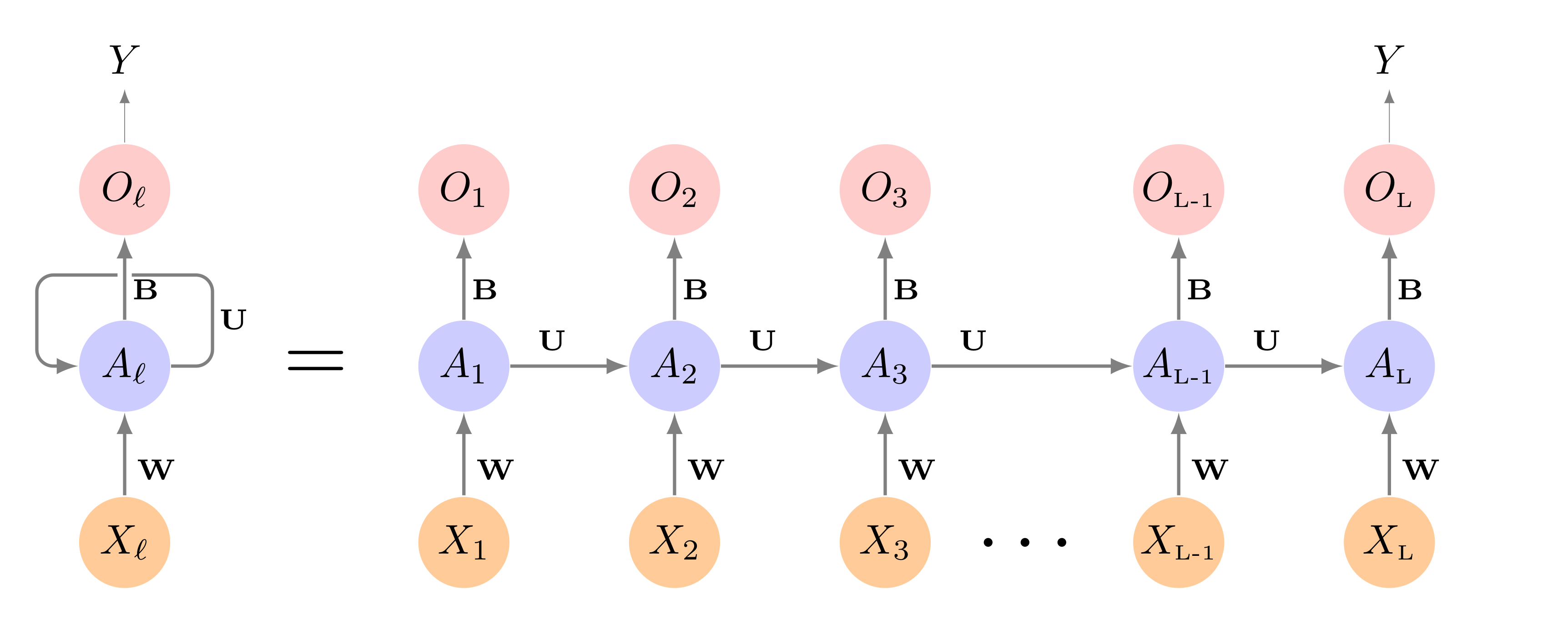
Source: ISLR2
RNN Neuron

RNN Neuron
Problems with RNN
- Recurrent Neural Networks suffer from exploding or disappearing gradient due the unfolding.
LSTM
The Long Short-Term Memory approach is used to conteract the issues with gradients by adding a “memory” structure to the nuerons.
This is done by incorporating 2 pathways, a long-term and short-term pathway.
LSTM Components
The creation of the 2 pathways are constructed using 3 “gates”:
- Input Gate
- Output Gate
- Forget Gate
Additionally, LSTM uses sigmoid and hyperbolic tangent activation functions to see what values will be incorporated into the pathways.
LSTM Neuron

LSTM Neuron
LSTM Architecture

LSTM Architecture
Forget Gate
The forget gate decides what information is useful from the long-term memory, and what information should be forgotten. The function below states what percent of the long-term memory should be remembered. \[ f_t = \sigma\left(\boldsymbol W_f [h_{t-1}, x_t] + b_f\right) \]
- \(W_f\) is the weighting matrix full of parameters
- \(b_f\) is the bias term
Input Gate
The input gate controls how the long term memory should be modified based on both the short-term memory and the new input. The \(i_t\) function tells us what percent should be remembered, and \(j_t\) tells us what to remember. \[ i_t = \sigma\left(\boldsymbol W_i [h_{t-1}, x_t] + b_i\right) \]
\[ j_t = \tanh\left(\boldsymbol W_j [h_{t-1}, x_t] + b_j\right) \]
- \(W_i\) and \(W_j\) is the weighting matrix full of parameters
- \(b_i\) and \(b_j\) is the bias term
Long-term Memory
This is how the long-term memory is modified
\[ C_t = f_t \bigodot C_{t-1} + i_t \bigodot j_t \]
- \(\bigodot\) is the element-wise multiplication of the vectors
Output Gate
The output gate tells us how is the short-term memory is updated. This is dony by figuring out what percent will be used from the new long-term memory.
\[ o_t = \sigma\left(\boldsymbol W_o [h_{t-1}, x_t] + b_o\right) \]
- \(W_o\) is the weighting matrix full of parameters
- \(b_o\) is the bias term
Short-term Memory
The short-term memory is costructed by combining the output gate and new long-term memory. \[ h_t = o_t\tanh\left(C_t\right) \]
This is also the new predicted value.
Predicting Electricity Demand
Sequential Data
Long Short-term Memory
Predicting Electricity Demand
Predicting Electricity Demand
We will use the vic_elec data set to be able to predict what the demand will be in a future time point.
Data Set
In order to fit a model with Torch, we need to provide a data set funcion that provides 2 values, a set of input and set of output. With Sequential data, values may be both outputs and inputs. We will use the dataset() to ensure that values can be used as both output and input.
RNN Neuron
Instead of the standard RNN Neuron, we will implement the Long Short-Term Memory Neuron.
Data Set
demand_dataset <- dataset(
  name = "demand_dataset",
  initialize = function(x,
                        n_timesteps,
                        n_forecast,
                        sample_frac = 1) {
    self$n_timesteps <- n_timesteps
    self$n_forecast <- n_forecast
    self$x <- torch_tensor((x - train_mean) / train_sd)

    n <- length(self$x) -
      self$n_timesteps - self$n_forecast + 1

    self$starts <- sort(sample.int(
      n = n,
      size = n * sample_frac
    ))
  },
  .getitem = function(i) {
    start <- self$starts[i]
    end <- start + self$n_timesteps - 1

    list(
      x = self$x[start:end],
      y = self$x[(end + 1):(end + self$n_forecast)]$
        squeeze(2)
    )
  },
  .length = function() {
    length(self$starts)
  }
)
demand_hourly <- vic_elec |>
index_by(Hour = floor_date(Time, "hour")) |>
summarise(
Demand = sum(Demand))
demand_train <- demand_hourly |>
filter(year(Hour) == 2012) |>
as_tibble() |>
select(Demand) |>
as.matrix()
demand_valid <- demand_hourly |>
filter(year(Hour) == 2013) |>
as_tibble() |>
select(Demand) |>
as.matrix()
demand_test <- demand_hourly |>
filter(year(Hour) == 2014) |>
as_tibble() |>
select(Demand) |>
as.matrix()
train_mean <- mean(demand_train)
train_sd <- sd(demand_train)
n_timesteps <- 7 * 24
n_forecast <- 7 * 24Model
model <- nn_module(
  initialize = function(input_size,
                        hidden_size,
                        linear_size,
                        output_size,
                        dropout = 0.2,
                        num_layers = 1,
                        rec_dropout = 0) {
    self$num_layers <- num_layers

    self$rnn <- nn_lstm(
      input_size = input_size,
      hidden_size = hidden_size,
      num_layers = num_layers,
      dropout = rec_dropout,
      batch_first = TRUE
    )

    self$dropout <- nn_dropout(dropout)
    self$mlp <- nn_sequential(
      nn_linear(hidden_size, linear_size),
      nn_relu(),
      nn_dropout(dropout),
      nn_linear(linear_size, output_size)
    )
  },
  forward = function(x) {
    x <- self$rnn(x)[[2]][[1]][self$num_layers, , ] |>
      self$mlp()
  }
)
initialize = function(input_size,
hidden_size,
dropout = 0.2,
num_layers = 1,
rec_dropout = 0) {
self$num_layers <- num_layers
self$rnn <- nn_lstm(
input_size = input_size,
hidden_size = hidden_size,
num_layers = num_layers,
dropout = rec_dropout,
batch_first = TRUE
)
self$dropout <- nn_dropout(dropout)
self$output <- nn_linear(hidden_size, 1)
}Training
input_size <- 1
hidden_size <- 32
linear_size <- 512
dropout <- 0.5
num_layers <- 2
rec_dropout <- 0.2

model <- model |>
  setup(optimizer = optim_adam, loss = nn_mse_loss()) |>
  set_hparams(
    input_size = input_size,
    hidden_size = hidden_size,
    linear_size = linear_size,
    output_size = n_forecast,
    num_layers = num_layers,
    rec_dropout = rec_dropout
)Predict and Visualize
demand_viz <- demand_hourly |>
  filter(year(Hour) == 2014, month(Hour) == 12)

demand_viz_matrix <- demand_viz |>
  as_tibble() |>
  select(Demand) |>
  as.matrix()

n_obs <- nrow(demand_viz_matrix)

viz_ds <- demand_dataset(
  demand_viz_matrix,
  n_timesteps,
  n_forecast
)
viz_dl <- viz_ds |>
  dataloader(batch_size = length(viz_ds))

preds <- predict(fitted, viz_dl)
preds <- preds$to(device = "cpu") |>
  as.matrix()

example_preds <- vector(mode = "list", length = 3)
example_indices <- c(1, 201, 401)

for (i in seq_along(example_indices)) {
  cur_obs <- example_indices[i]
  example_preds[[i]] <- c(
    rep(NA, n_timesteps + cur_obs - 1),
    preds[cur_obs, ],
    rep(
      NA,
      n_obs - cur_obs + 1 - n_timesteps - n_forecast
    )
  )
}

pred_ts <- demand_viz |>
  select(Demand) |>
  add_column(
    p1 = example_preds[[1]] * train_sd + train_mean,
    p2 = example_preds[[2]] * train_sd + train_mean,
    p3 = example_preds[[3]] * train_sd + train_mean) |>
  pivot_longer(-Hour) |>
  update_tsibble(key = name)

pred_ts |>
    ggplot(aes(Hour, value, color = name)) +
      geom_line() +
  scale_colour_manual(
    values = c(
      "#08c5d1", "#00353f", "#ffbf66", "#d46f4d"
    )
  ) +
  theme_minimal() +
  theme(legend.position = "None")
m408.inqs.info/lectures/10a